


This article is part of our coverage of the latest in AI research.
Traditional robot programming relies on rigid pipelines that struggle to gracefully manage physical dynamics, environment configurations, and failures.
ASPIRE, a framework developed by Nvidia in collaboration with researchers from multiple universities, solves this challenge with a continual learning approach that lets artificial intelligence systems write, execute, and refine robot control programs autonomously.
ASPIRE diagnoses its own errors and distills successful repairs into a reusable skill library. This aligns with broader industry trends where reasoning models are increasingly used to let AI agents improve their own scaffolding.
For real-world AI applications, this technique is highly relevant because it significantly reduces the programming, token, and debugging effort required on physical robots, even across different hardware embodiments and application programming interfaces.
Like other niches of AI, ASPIRE signals a shift toward self-improving, agentic systems that accumulate transferable knowledge and help accelerate the adaptation and deployment of robotic systems in complex, open-world environments.
The challenges of robotic coding agents
Recent advancements in AI coding agents have shown that large language models can review execution traces, find errors, and iteratively refine code. In robotics, this progress has helped bring about the “code-as-policy” paradigm, which translates robot behaviors into executable programs that combine perception tools, APIs, and control actions. Rather than outputting raw motor torques, the AI generates Python scripts that directly control the hardware. Because the robot’s actions are written as code, these programs can be examined, debugged, and improved using interaction feedback.
However, existing robotic coding agents face major hurdles because they operate in naive environments that supply only coarse, task-level feedback. Debugging a robot program is difficult due to the many interacting components such as multimodal perception, contact dynamics, grasp generation, and motion planning.
For example, if a robot fails an execution rollout, a basic failure signal does not reveal whether the root cause was a faulty camera perception, an unstable physical grasp, or a collision error from the motion planner. Without fine-grained diagnostic traces to pinpoint what went wrong, agents struggle to determine what evidence to inspect, localize the failure, or figure out an effective repair strategy.
Furthermore, current systems do not accumulate experience. When existing agents successfully resolve a problem, they don’t remember the fixes and recovery strategies they generated for future tasks.
Consequently, an AI agent attempting its hundredth task remains effectively no more experienced than an agent attempting its very first task.
This approach contrasts sharply with how human robotics engineers solve problems. When a robot program fails, human engineers replay the execution, analyze perception outputs and motion trajectories, isolate the failing subsystem, and rewrite the code. More importantly, they internalize these solutions, compounding their debugging experience into transferable knowledge that generalizes across different tasks.
For instance, a human engineer might develop specific grasp recovery heuristics, reusable perception prompting recipes, or procedural navigation strategies, such as explicitly commanding the robot to sample alternative approach angles if a target object is placed too close to a table’s collision boundary. By continually accumulating this reusable knowledge, human programmers become progressively better over time.
How the ASPIRE framework works
To solve these limitations, the researchers introduced ASPIRE, which stands for Agentic Skill Programming through Iterative Robot Exploration. At a high level, ASPIRE is an AI framework that acts like a senior robotics engineer. Instead of treating every new task as an isolated challenge, ASPIRE operates as a continual learning system for robotics. The more problems it encounters, the more capable it becomes.
It achieves this by autonomously writing and refining robot control programs. Essentially, the AI acts as a software developer, writing the underlying Python code that dictates the robot’s perception and motion, and then autonomously debugging that code when the robot fails. It then records new experience so it can be applied to new tasks in the future.
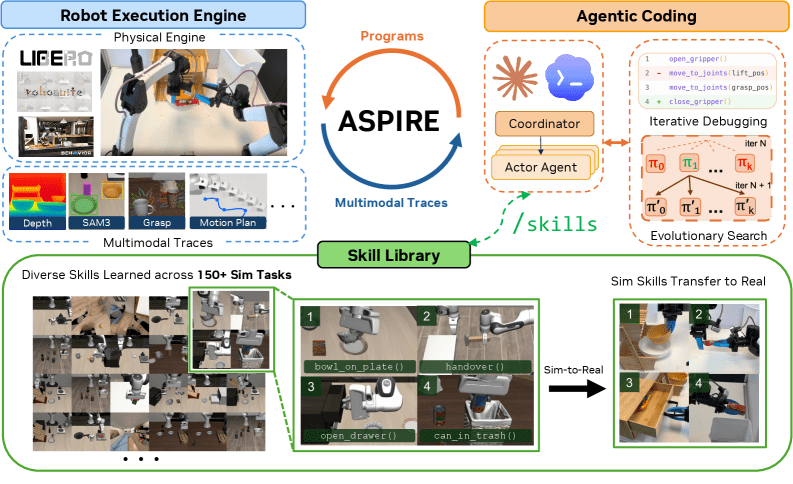
Historically, robots have been trapped in a fixed perception-plan-execute pipeline. The camera looks, the software calculates a path, and the arm moves. If an unexpected variable interrupts this rigid sequence, the system halts. ASPIRE abandons this static approach in favor of an open-ended learning loop. In this model, the agent determines how to investigate a failure, inspects execution traces, diagnoses the root cause, writes a software patch, validates the new behavior, and consolidates new information into its long-term memory.
The framework achieves this self-improving loop through three integrated components. The first is a “closed-loop robot execution engine” that acts as the debugging environment. Instead of just telling the agent that the task failed, the engine provides multimodal traces. It acts like an airplane’s black box, recording what the robot saw, what the code outputted, where the motion planner threw an error, and the visual keyframes right before and after the failure. This allows the agent to pinpoint which specific line of code or physical interaction went wrong.
The second component is the “skill library,” which serves as ASPIRE’s compounding brain. When the agent validates a successful repair, a central coordinator distills it into a reusable rule or heuristic and stores it. It catalogs everything from localization tricks and grasping constraints to debugging workflows. Future agents can then retrieve these skills as in-context guidance to get a head start on complex assignments.
The third component is an “evolutionary search procedure.” In machine learning, an agent can sometimes get stuck in a local minimum, tweaking the exact same failed logic without making progress. To prevent this, ASPIRE uses evolutionary search to generate a diverse population of alternative control programs and task strategies. It tests multiple code mutations in parallel, allowing the system to explore fundamentally different ways to solve a problem rather than perpetually refining a single failed trajectory.
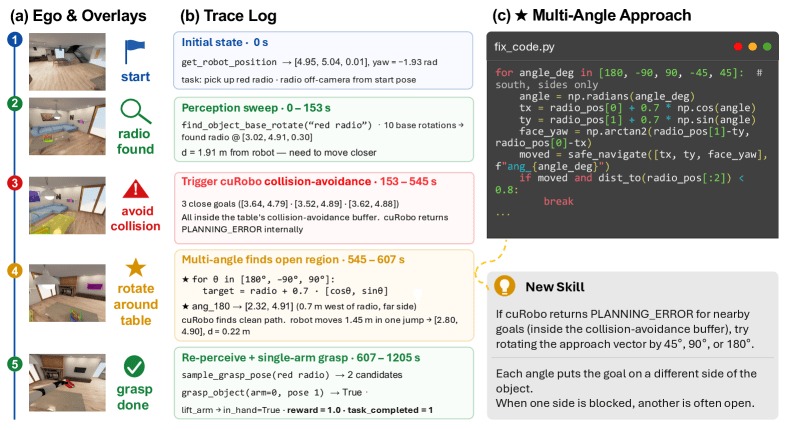
To see how this works in practice, imagine an enterprise deploying a mobile manipulator to pick up a red radio from a crowded workbench. The robot spots the radio but refuses to approach it, reporting a failure. To diagnose the error, the robot execution engine pulls the logs. The agent reviews the trace and sees that the perception system worked perfectly, but the motion planner repeatedly threw a planning error. This happened because the navigation target was mathematically too close to the table’s edge, triggering a hidden collision-avoidance safety buffer.
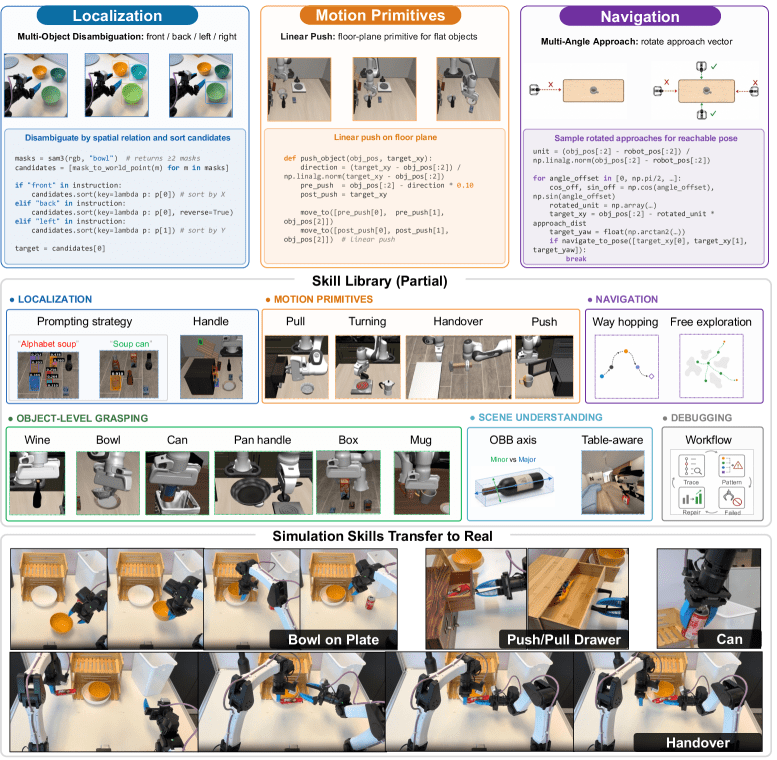
Using evolutionary search, the agent proposes multiple solutions. Instead of tweaking the perception prompt, it writes a patch that tells the robot to sample alternative approach directions, checking 45-degree, 90-degree, and 180-degree angles to find a valid path that completely avoids the safety buffer. The engine executes the new code, and the robot successfully grasps the radio. ASPIRE extracts this multi-angle approach routine and permanently saves it to the skill library.
The real value of this self-improving system is that it transcends simulation. ASPIRE provides strong initial evidence of sim-to-real transfer. Because the system learns fundamental physical heuristics rather than just memorizing a specific task, the skills discovered in a high-speed simulation can be imported directly into real, physical robots. Even if the factory robot has a different mechanical design or uses different application programming interfaces, retrieving these pre-learned skills dramatically reduces the time, token cost, and engineering effort required to program robots for real-world enterprise environments.
ASPIRE in action
To evaluate the system, the researchers powered ASPIRE’s core coding agent using Claude Opus 4.6. They tested the framework across three simulated benchmark families that evaluate models on different robotic navigation and manipulation tasks across short and long horizons, as well as under various environmental conditions. To test real-world transfer, they used OpenAI Codex with GPT-5.5 to control a physical bimanual robot that featured a completely different physical embodiment and programming interface than the simulator.
The system was compared against leading state-of-the-art baselines, including coding agents like CaP-Agent0, which relies on test-time retries rather than accumulating experience.
It was also tested against end-to-end vision-language-action models including OpenVLA, pi0, and pi0.5, and even against programs manually written by human experts.
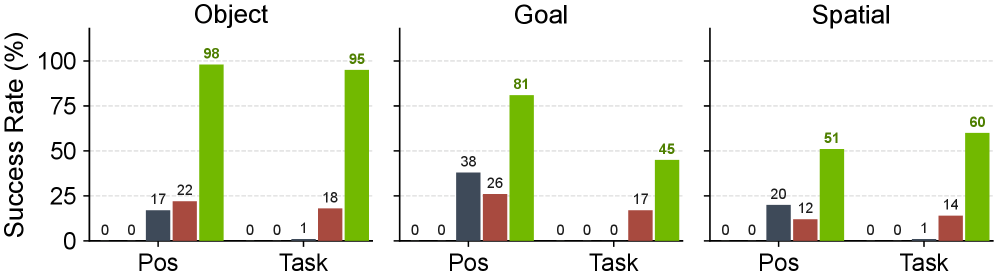
The quantitative results demonstrate massive improvements across the board. On the LIBERO-Pro benchmark, ASPIRE outperformed all baselines, improving success rates by up to 77 percentage points on object perturbations. On the Robosuite benchmark, it took a complex bimanual handover task from a mere 20% success rate up to an impressive 92%. On the long-horizon BEHAVIOR-1K tasks, ASPIRE surpassed both the strongest AI baseline and human experts in navigation and task execution. Additionally, when applying its accumulated skill library to unseen long-horizon tasks, the system achieved a 31% zero-shot success rate, drastically outperforming prior methods that saturated at just 4%.
For real-world applications, the most compelling takeaway is how ASPIRE’s accumulated experience improves operational efficiency and cuts computational costs. Because ASPIRE extracts generalized repair logic rather than memorizing a specific simulator’s code, skills discovered in simulation can serve as in-context guidance for entirely different physical robots.
A perfect anecdote of this efficiency can be seen in the real-world deployment experiments. When a physical robot was tasked with lifting a soda can, feeding the agent a previously learned simulation skill reduced the total reasoning tokens required for debugging by nearly an order of magnitude, dropping from roughly 61.94 million tokens to just 6.58 million, while boosting the final success rate from 13/20 to 19/20. The impact was even more dramatic on a complex drawer manipulation task. Without the transferred skill, the agent burned through a massive budget of nearly 335 million tokens without a single success. But with the transferred skill, it achieved an 11/20 success rate using only a fraction of the computational budget, totaling 81.67 million tokens.
The researchers plan to open-source the code to allow developers to explore and build upon this self-improving robotic framework. With models consistently improving in their reasoning capabilities, frameworks like ASPIRE mark a critical step toward an era where robotic fleets learn, adapt, and refine their own programming seamlessly in the background.
The rise of loop engineering in robotics


Subscribe to continue reading
Become a paid subscriber to get access to the rest of this post and other exclusive content.