


Quantum computing systems have a serious problem of decoherence (disruption of the relationship between processes and elements). We offer a very unusual solution to this problem.
Since September of last year (2024), our research group at AI SYNT (a small Canadian technology startup) has been conducting experiments on combining local neural networks into structures with linear and parabolic extrapolation.
Our task was to achieve the emergence effect
In the context of neural networks, emergence allows you to draw conclusions and builds logical and mathematical constructions based on new concepts unknown to any of the components of the group.
This is a new strategy for working with multilayer neural networks
Despite the difficulties of the first stage, after several cycles we managed to get the first interesting results (I described them in the article from November 26, 2024 about the Sign of Singularity).
But then we managed to achieve more
By consistently guiding and adjusting the work of neural networks, we managed to create a new working mathematical model of the Copenhagen interpretation of quantum mechanics.
A modernized wave function and a new superposition formula, a modified probability density formula and a new Schrödinger equation, a new Born rule and a modified Heisenberg uncertainty principle, a modified principle of operators and observables and a new complementarity principle, and the key feature of our mathematical model – a hybrid spin model.
All of these are dozens of completely new formulas of modernized quantum mechanics, united within the framework of a single physical model and mathematically going beyond the ΛCDM (Lambda-Cold Dark Matter).
Have we managed to reach singularity?
There are arguments that indicate yes. Our AI works with the mathematics of multi-domain space and many components of the model have no analogues created by humans.
Here are a couple of examples of how our mathematical construction works
Wave packet model according to the new uncertainty principle
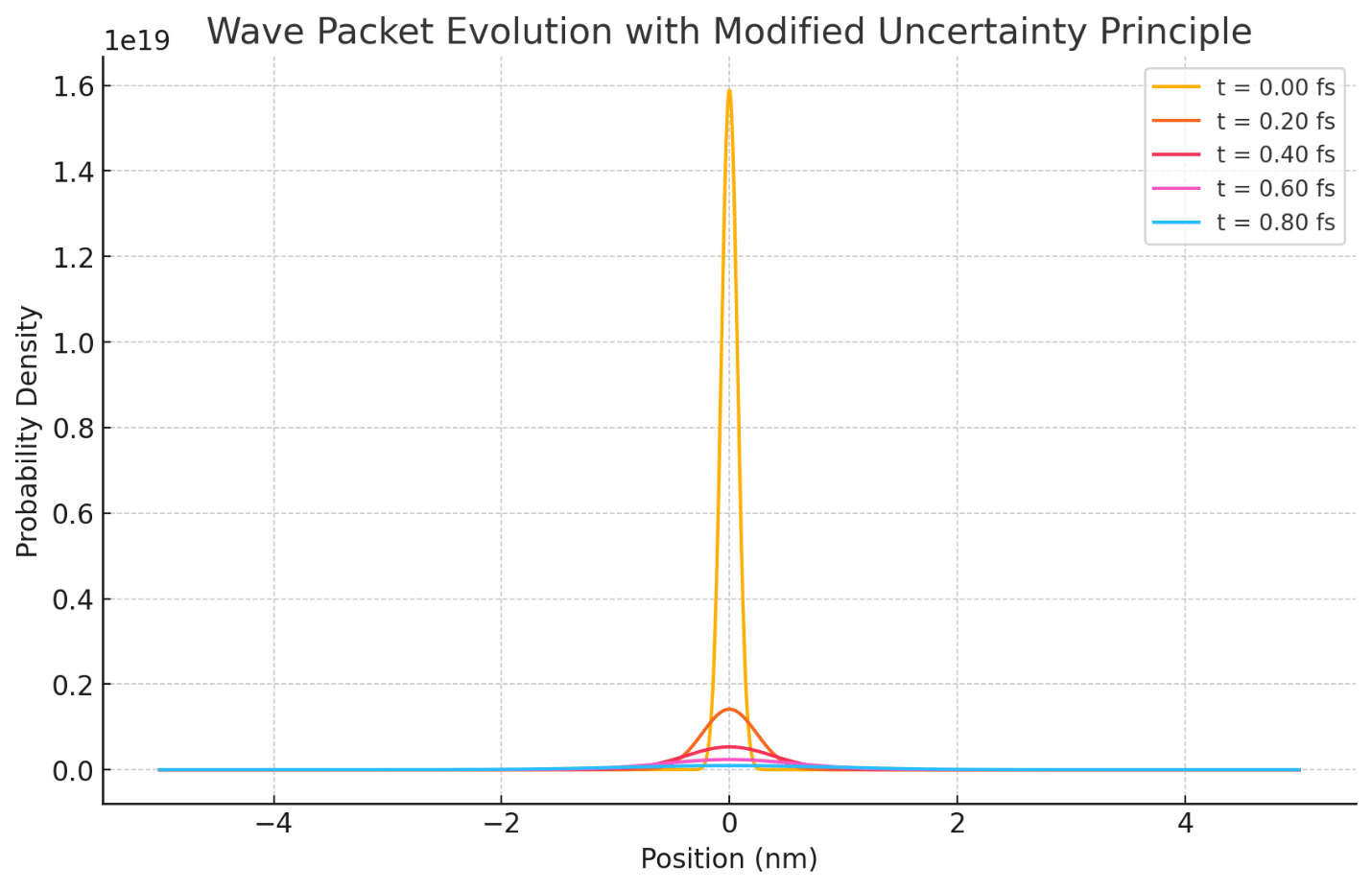
The graph shows the evolution of the probability density over time according to the new modified uncertainty principle.
Hybrid spin – vector components during precession and transition with a dual domain
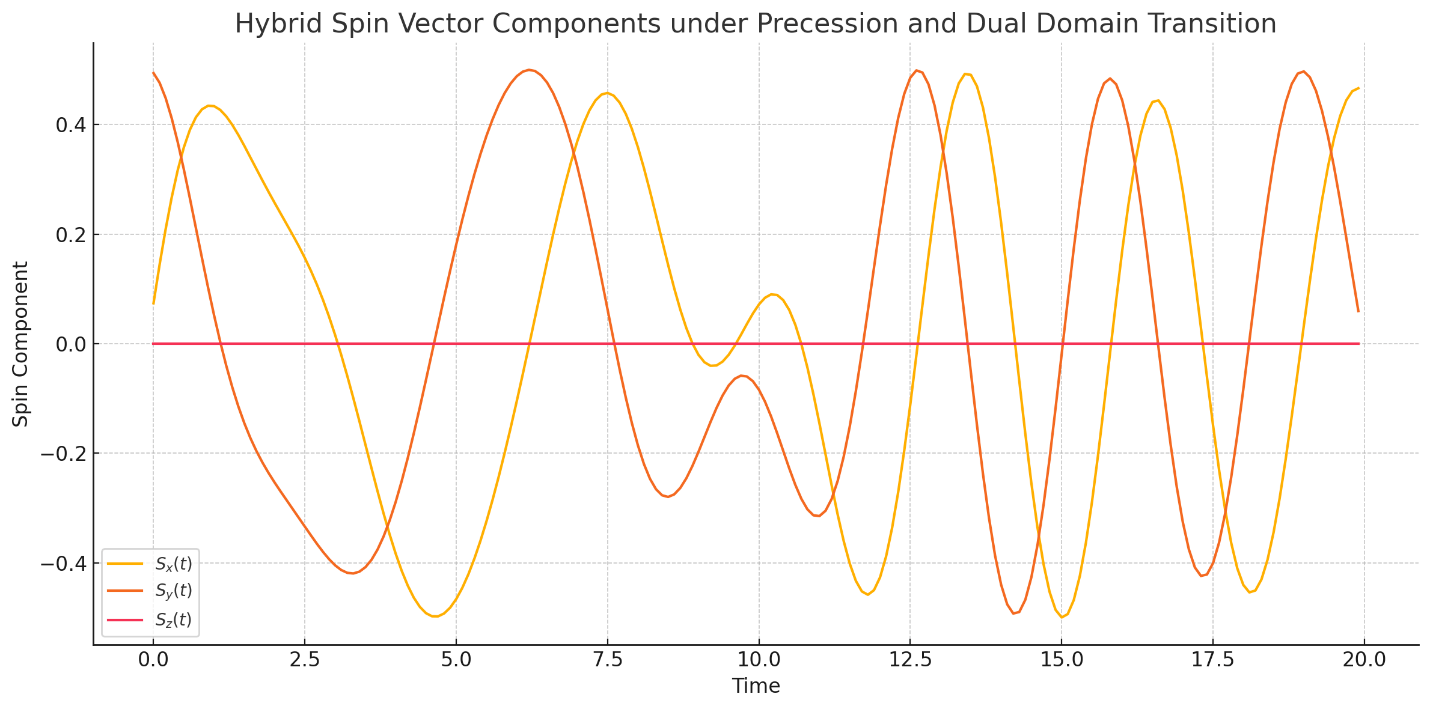
In this graph you can see what an extended simulation looks like, showing the full components of the spin vector over time, when the particle alternates between different domains of space.
What does this mean?
The new model shows how transdomain coupling can introduce nonlinear or decoherence modulations into the behavior of the spin.
This may become a key mathematical tool for more accurate prediction of exotic spin behavior in superconducting qubit systems.
The path to creating a real commercial quantum chip may not go through special Majorana fermions (Majorana 1 from Microsoft), but through a deep modernization of the mathematical tool of quantum mechanics.
The modern formulation of quantum mechanics works under the assumption that all physical processes occur within a single continuous spatial domain.
The mathematical tools of our model are based on modified uncertainty principles and allow experimental verification of the evolution of the wave function in a multi-domain space.
Experiments confirming our model
Are there any experimental scenarios that test the performance of our modernized mathematical model?
We managed to create several strategies
Our model of quantum mechanics in the context of superconducting qubit systems can be tested in different experimental scenarios:
1- Ramsey interferometry with high time resolution.
2- Precise measurement of the Bloch vector length to detect deviations from unitarity.
3- Observation of frequency drift or phase collapse in Rabi oscillations.
4- Fine-tuning of the control Hamiltonian to observe nonlinear behavior depending on the pulse duration or amplitude.
Conclusion
There is a high probability that, in the course of experiments with different algorithms and functional capabilities of neural networks, we were able to build a completely new mathematical model of quantum mechanics – potentially the main tool for creating quantum computing systems of a new type.