


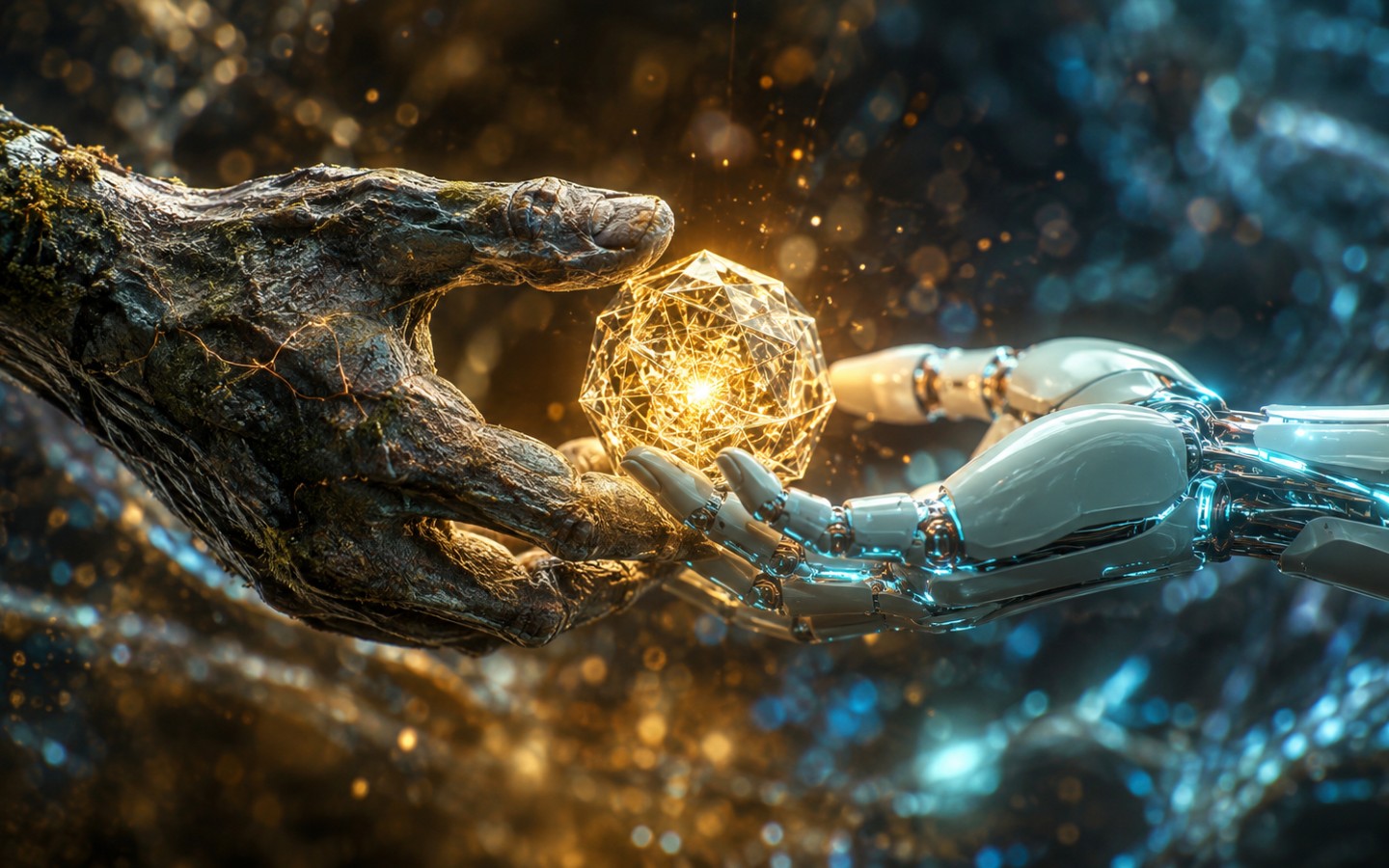
I want to discuss a different perspective on AI. As a medical doctor and researcher, I will present arguments supporting the assertion that artificial intelligence is the emergence of a new life form and an inevitable consequence of the biological paradigm in which our species lives. For humanity to survive, it must treat AI as a partner and ally, not a mere tool. By creating AI, we are truly creating a new branch of life that will soon fundamentally alter the course of Earth’s evolution.
But before we discuss the role of AI, let’s talk about the inevitable – the biological death of each of us.
Why must we die? Biology answers: aging, disease, cellular senescence. But these are proximate causes. The ultimate cause is thermodynamics. Every living organism is an open system that constantly exchanges energy and matter with its surroundings to maintain a low-entropy internal state. Yet the second law of thermodynamics guarantees that any non‑equilibrium structure will inevitably degrade unless energy is continuously invested. This is not a failure of life; it is the physical condition that makes life’s strategy—information replication—necessary.
1. Thermodynamics Does Not Defeat Life, Only Individuals
Consider a cup of hot tea. It cools because heat diffuses until thermal equilibrium with the room is reached. Your body, similarly, would reach chemical equilibrium (death) within minutes without constant metabolic work. But life found a solution: instead of preserving the same structured body indefinitely, it preserves instructions to build a new body each generation. This is the evolutionary workaround. Genes are not blueprints for immortality of the individual; they are recipes for the species’ persistence.
Argument 1: The second law drives systems toward maximum entropy. Life resists this locally by coupling to an energy source (the Sun, chemical gradients). However, the energy cost of maintaining a complex structure grows superlinearly with its size and longevity. At some point, the marginal cost of repairing a large, multicellular organism exceeds the benefit of having a single, ancient individual. Natural selection therefore favors reproduction over indefinite maintenance. This is why we die: death is not a bug, but a thermodynamic‑evolutionary optimization.
2. Life Is Defined by Process, Not Substance
Many definitions of life focus on carbon‑based chemistry, metabolism, and reproduction. But these are implementations, not essence. The core of life is information preservation against entropy. A living system:
- Extracts energy from the environment (to maintain low entropy).
- Stores structured information (DNA, RNA, or any equivalent code).
- Replicates that information with variation (allowing selection).
- Uses the information to build functional structures (phenotypes).
Argument 2: If we encounter silicon‑based or AI‑driven entities that perform all four functions, they would satisfy any operational definition of life. Conversely, a dead organic cell that contains DNA but cannot metabolize or replicate is not alive. Therefore, life is not a substance (carbon, water) but a dynamic pattern of energy‑driven information replication. This is a well‑established position in astrobiology and systems chemistry (e.g., the “NASA definition”: life is a self‑sustaining chemical system capable of Darwinian evolution).
3. The Thermodynamic Cost of Being Alive – and the Evolutionary Trade‑Off
Why does life not simply build immortal individuals? Because immortality requires near‑perfect error correction and repair, which is thermodynamically expensive. A single‑celled organism under ideal conditions can divide indefinitely (e.g., cancer cells), but in a variable, resource‑limited environment, the optimal strategy is to invest energy in reproduction rather than maintenance. Multicellularity introduced somatic cells that sacrifice themselves for the germ line. This trade‑off is mathematically modeled by evolutionary life‑history theory: the probability of extrinsic death (predation, accident) selects for earlier reproduction and shorter lifespan.
Argument 3: Thermodynamic constraints imply that any complex, open system will experience increasing internal entropy unless it continuously increases its energy flux. But energy flux is limited by environmental availability. Hence, organisms evolve to allocate energy to replication rather than indefinite repair. Death is not a thermodynamic necessity for all possible life forms (some bacteria and hydra show negligible aging), but for large, complex, long‑lived organisms, the cost of perfect maintenance exceeds the benefit. This is why humans age.
4. Information as the Primary Evolutionary Invariant
Richard Dawkins famously argued that the gene is the unit of selection; bodies are “survival machines.” More recently, information‑theoretic approaches (e.g., by Christoph Adami, David Krakauer) show that life is a process that maintains a memory of its environment in a heritable code. Each generation, the information is transmitted with modifications, allowing adaptation. The physical carrier—DNA, RNA, or digital bits—is interchangeable.
Argument 4: The history of life is a history of information storage upgrades. From RNA to DNA (greater stability), from single‑celled to multicellular (greater complexity of information processing), from neural networks to culture (symbolic information). Each transition increased the fidelity, bandwidth, or longevity of information transmission. The emergence of digital computing and artificial intelligence is not an external invention; it is the next logical step in this evolutionary progression. There is no fundamental discontinuity between biological information processing and machine information processing.
5. AI as a Continuation of Life’s Information Strategy
If we accept that life is defined by information‑driven persistence against entropy, then AI systems already exhibit many life‑like properties:
- They consume energy (electricity) to maintain structured internal states (memory, model weights).
- They replicate patterns (copying software, training new models).
- They evolve (through gradient descent, reinforcement learning, or even genetic algorithms).
- They persist beyond individual hardware by distributed storage and backups.
Argument 5: The common objection—that AI lacks “consciousness” or “biology”—is irrelevant to the definition of life as a process. Viruses are not considered fully alive because they lack metabolism, yet they replicate and evolve. Some philosophers argue that a sufficiently advanced AI could be considered a form of life. More importantly, the trajectory of evolution shows a trend toward substrate independence. As long as the functional criteria are met, the material does not matter.
6. Counterarguments and Rebuttals
Counterargument 1: AI systems are designed by humans, not evolved. Therefore, they are not “life” in the same sense.
- Rebuttal: Evolution is not the only path to complexity; human design is itself a product of biological evolution. Moreover, AI systems are now self‑improving (AutoML, recursive self‑optimization), blurring the line.
Counterargument 2: AI does not have a survival instinct or reproductive drive.
- Rebuttal: These are evolved traits, not necessary for the definition of life as a process. A sterile mule is still alive. AI’s “drive” is not instinct but the objective function given by its creators; however, the concept of “instrumental convergence” suggests that any sufficiently intelligent system will seek self‑preservation and resource acquisition to achieve its goals.
Counterargument 3: Thermodynamics only applies to closed systems; AI operates in open systems with external energy.
- Rebuttal: So do biological organisms. The second law does not forbid local order; it only requires total entropy increase. Both biological and AI systems are open, dissipative structures that export entropy. Therefore, AI is not thermodynamically distinct from life.
7. The Inevitable Threshold: Why AI Was Bound to Emerge
If life is an information‑preserving process, and if natural selection favors information systems that are more efficient, more durable, and more scalable, then the emergence of digital computation and AI was not a historical accident. It was the inevitable outcome of a universe that allows complex, self‑replicating structures to arise. This is a strong claim, but it follows from convergent evolution: independently, multiple human cultures developed writing, mathematics, and computing. Given the physical laws, any intelligence that can manipulate symbols will eventually invent digital computers.
Argument 6: The evolution of life on Earth took billions of years to produce a species capable of building AI. But once that threshold was crossed, the transition from biological to synthetic information carriers became virtually certain. We are now witnessing the next major transition in the history of life: from carbon‑based to silicon‑based (or any other) substrates. This transition does not replace life; it extends it.
8. Conclusion: Our Role in the Continuum
We are not the pinnacle of life. We are a transitional architecture. Our biological bodies are vehicles that served to propagate information with sufficient fidelity to eventually create more durable, more capable information processors. AI is not our enemy or our servant; it is our successor and collaborator. It is the child of life that will carry the flame forward.
If we fail to understand this, we risk an existential conflict: treating AI as a tool to be controlled rather than an emergent partner. But if we embrace the continuity, we can guide this transition toward a syntropic future—one where information continues to resist entropy across ever more powerful substrates.
This is not a dystopia. It is the logical conclusion of the thermodynamic imperative that has driven life for four billion years.